Peter's electronic projects Peter's electronic projects
 Try it now, before building! Click on the transmitter buttons with the
green
labels
on the left and see how the receiver outputs (K1-K8) change. Change
the number of transmitter or receiver channels. Switch the receiver
output type between latched and momentary.
Try it now, before building! Click on the transmitter buttons with the
green
labels
on the left and see how the receiver outputs (K1-K8) change. Change
the number of transmitter or receiver channels. Switch the receiver
output type between latched and momentary.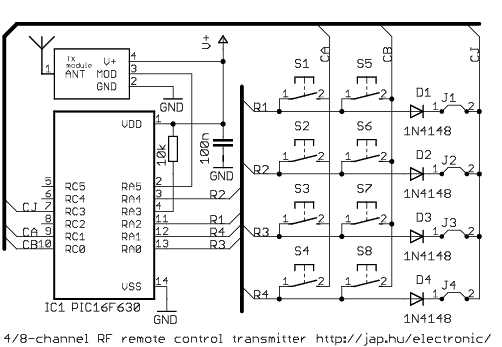
| part | description |
| C1 |
100nF ceramic capacitor |
| R1 |
10k resistor (1/8W) |
| D1-D4 | 1N4148 diode (optional) |
| S1-S8 |
tact switch, DTSM 61N or similar |
| IC1 | PIC16F630 or PIC16F676 microcontroller, pre-programmed |
| TXMOD |
radio
transmitter module, see text (hardware) |
| B1 |
battery between 2-5.5VDC (check TXMOD specs for valid voltage range) |
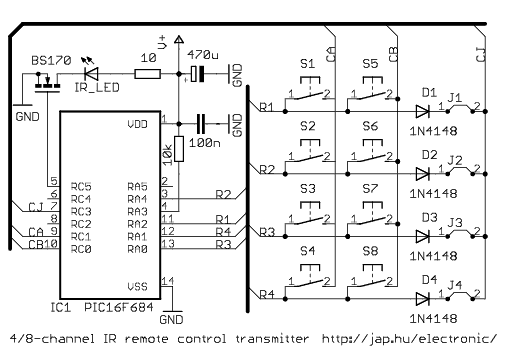
| part | description |
| C1 |
100nF ceramic capacitor |
| C2 |
470 uF 6.3V, electrolytic
capacitor |
| R1 |
10k resistor (1/8W) |
| R2 |
10 ohm resistor (1/4W) |
| D1-D4 | 1N4148 diode (optional) |
| D5 |
IR transmitter LED |
| Q1 |
BSS138 or similar N-MOSFET |
| S1-S8 |
tact switch, DTSM 61N or similar |
| IC1 | PIC16F684 microcontroller, pre-programmed |
| B1 |
battery between 2-5.5VDC (CR2032, 3.6V LiIon battery or 3xAA
batteries) |
| please
observe the corresponding address configuration! |
|
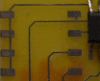 transmitter: no diodes connected |
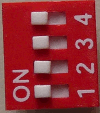 receiver: switches all ON |
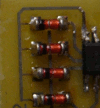 transmitter: all diodes connected |
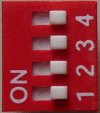 receiver: switches all OFF |
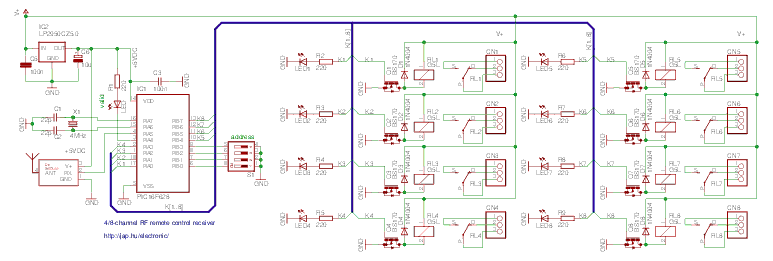
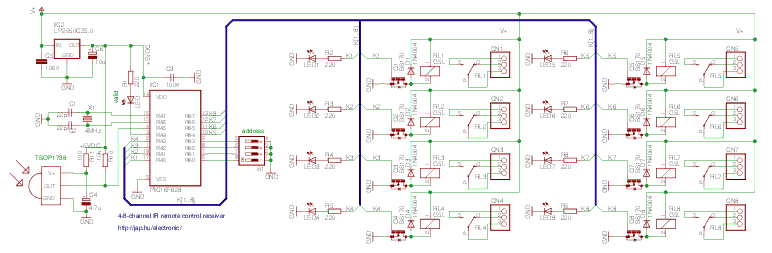
parts list
| part | description |
| C1, C2 | 22pF ceramic capacitor |
| C3, C5 | 100nF ceramic capacitor |
| C6 | 10uF 6.3V electrolytic capacitor |
| CN1-CN8 | PCB terminal block, 3-way (DG301) |
| D1-D8 | 1N4004 diode |
| IC1 | PIC16F627 or PIC16F628 or PIC16F627A or PIC16F628A microcontroller, pre-programmed |
| IC2 | LP2950CZ5.0 voltage regulator |
| LED | 3mm LED (green) |
| LED1-LED8 | 3mm LED (red) |
| Q1-Q8 | BS170 N-channel mosfet transistor |
| R1-R9 | 220R resistor (1/8W) |
| RL1-RL8 | G5LE relay, see text for coil voltage selection |
| S1 | piano DIP switch, 4-way |
| X1 | 4MHz HC49 crystal |
| RXMOD | 3-pin radio receiver module, see text (hardware) |
| please
observe the corresponding address configuration! |
|
| transmitter: no diodes connected |
receiver: switches all ON |
| transmitter: all diodes connected |
receiver: switches all OFF |
While entertainment industry documentaries offer a unique perspective on the industry, they also face several challenges and limitations. Some of these challenges include:
The entertainment industry thrives on illusion. For over a century, Hollywood and the global media landscape have carefully manufactured glamour, stardom, and seamless storytelling. However, a powerful genre of filmmaking has broken through this polished facade. Entertainment industry documentaries—films and docuseries that investigate show business itself—have exploded in popularity.
This public link is valid for 7 days and shares a thread, including any personal information you added. This link or copies made by others cannot be deleted. If you share with third parties, their policies apply. Can’t copy the link right now. Try again later.
Recent investigative projects have exposed long-standing patterns of harassment and abuse. These films demonstrate how powerful executives use their status to silence victims and protect institutions. Impact on Audience Perception GirlsDoPorn.E374.18.Years.Old.XXX.720p.WEB.x264...
The documentary opens with a montage of red carpet appearances, talk shows, and movie premieres, showcasing the glamorous side of the entertainment industry. But as the camera cuts to interviews with industry professionals, a different story emerges.
Recent projects explore the financial realities of the streaming era, illustrating how the shift away from physical media and traditional broadcast residuals has destabilized the middle-class writer and actor. By documenting historic events like the joint WGA and SAG-AFTRA strikes, filmmakers are recording history as it happens, capturing an industry fighting to preserve human creativity against corporate optimization. The Lasting Impact of the Genre
Many industry documentaries act as time capsules. They allow us to relive iconic cultural eras—like the 1990s indie film boom or the MTV era—through a mature, reflective lens. The Ethical Dilemma: Truth vs. Access However, a powerful genre of filmmaking has broken
: Content created specifically for social change or charity, often managed by specialized "Documentary Impact Producers". Distribution and Sale
Often seen in celebrity-focused documentaries where the subject is an active participant in crafting their own narrative. 3. The Power of "Soft Power" and Advocacy
The true turning point arrived with the streaming boom. Platforms like Netflix, HBO, Hulu, and Apple TV+ recognized a insatiable appetite for true stories. Documentarians began securing the editorial independence and budgets needed to treat the entertainment industry not as a dream factory, but as a subject worthy of rigorous investigative journalism. Today, an entertainment industry documentary is just as likely to expose systemic labor exploitation or psychological trauma as it is to celebrate creative genius. The Sub-Genres of Entertainment Documentaries This link or copies made by others cannot be deleted
To be considered effective within the industry, these documentaries generally include:
By continuing to hold a mirror up to Hollywood, the entertainment industry documentary ensures that while the show must go on, the truth will no longer be left on the cutting room floor. If you want to explore this topic further, tell me:
LATCH_MASK EQU B'00001111' sets channels 8-5 to momentary
and
channels 4-1 to latched (toggle) mode. Then use the compiler (MPLAB or
gputils) to
assemble the code.clrf
0x91 ;
ANSEL