

Want to take The Living Arabic Project's dictionaries wherever you go? Download the mobile app Lughatuna! It costs a little bit, but purchasing it supports the project so more cool dictionaries and new features can be added.


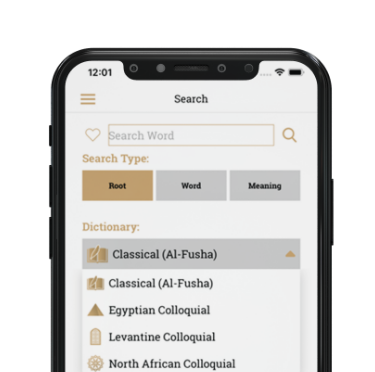
This site is always growing. What started out as a simple word list on a student’s desktop has evolved into two of the largest dialect dictionaries ever written for the Egyptian and Levantine dialects with plans for additional dialects and a growing Classical Arabic (Fusha) dictionary, all run on a uniquely structured database designed for Arabic’s diglossia. To make it practical and accessible, there are apps and learning resources appropriate for all levels of users.





Arabic is hard and complex, but also rich and deep. Imagine learning tools that map out Arabic for you and help you learn it. That’s what this site is. It has dictionaries for Egyptian, Levantine, and Classical Arabic, and it has apps and learning resources to help you access the language.
These dictionaries are more than just a list of words, they are guides to the Arabic language. The uniquely structured database allows users to search by Arabic word, English word, and Arabic root. There are also thousands of examples to show users how to properly use words and listing common phrases and proverbs.
By 7:00 PM, the focus shifts indoors to the "homework hustle." Education is highly prioritized in Indian culture, and evenings are dominated by school projects, math tuition, and exam preparation. Parents take an active role, sitting with children at the dining table to review notebooks, ensuring that academic expectations are met. The Dinner Ritual: Disconnect to Reconnect
As the sun sets, Indian neighborhoods come alive with sound. Around 5:00 PM, children flood the colony parks and apartment courtyards for chaotic games of street cricket, badminton, or tag.
While the traditional "joint family" system—where three or more generations live under one roof—is evolving into nuclear setups in urban centers, the spirit of the joint family remains. Even in high-rise apartments in Mumbai or Bangalore, the "extended family" is just a WhatsApp group away. free hindi comics savita bhabhi 28 29 30 31 link
Daily routines are structured yet punctuated by spontaneous social interactions.
In urban apartments, the afternoon brings a quiet lull. For those working from home or managing the household, this is a time for a light lunch—usually leftovers from dinner or simple dal-chawal (lentils and rice)—followed by a short rest. In the rural heartlands, this time is spent under the shade of neem trees, sewing, shelling peas, or organizing the pantry. The Evening Reunion: Park Playdates and Homework Hustle By 7:00 PM, the focus shifts indoors to the "homework hustle
The Indian day begins early, often announced by the sharp whistle of a pressure cooker or the rhythmic sweeping of the front porch. In many households, the first person awake is a grandparent, starting their morning with quiet prayers, yoga, or devotional music playing softly in the background.
"We moved to a high-rise apartment last year," says Kavita Joshi, a software marketer. "My mother-in-law lives in the old family bungalow. We are 'separate' on paper. But my husband cannot eat dinner without her pickle. I cannot make a financial decision without her advice. Our daily life stories are still entangled—just via WhatsApp now." Around 5:00 PM, children flood the colony parks
The morning brings the sabziwala (vegetable vendor) pushing a wooden cart down the street, calling out the day's fresh produce. Homemakers gather at balconies or gates to negotiate prices, exchanging neighborhood gossip alongside rupees. Domestic helpers arrive to sweep, mop, and wash dishes, often becoming extended members of the family who share in the household's daily joys and sorrows.
The true catalyst of the morning, however, is Chai . The brewing of morning tea—steeped with ginger, cardamom, and milk—is a sacred daily ritual. Family members gather around the kitchen island or dining table for a quick cup, catching up on the morning newspaper and discussing the day's schedule before the rush of school buses and office commutes begins. The Midday Rhythm: Neighborhood Networks and Quiet Hours
Grandparents often serve as the "Learning Express," sharing ancestral stories and pearls of wisdom about humility and respect. Cultural Nuances and Modern Challenges
Do you have questions or comments?
Feel free to reach out through Contact us page.
